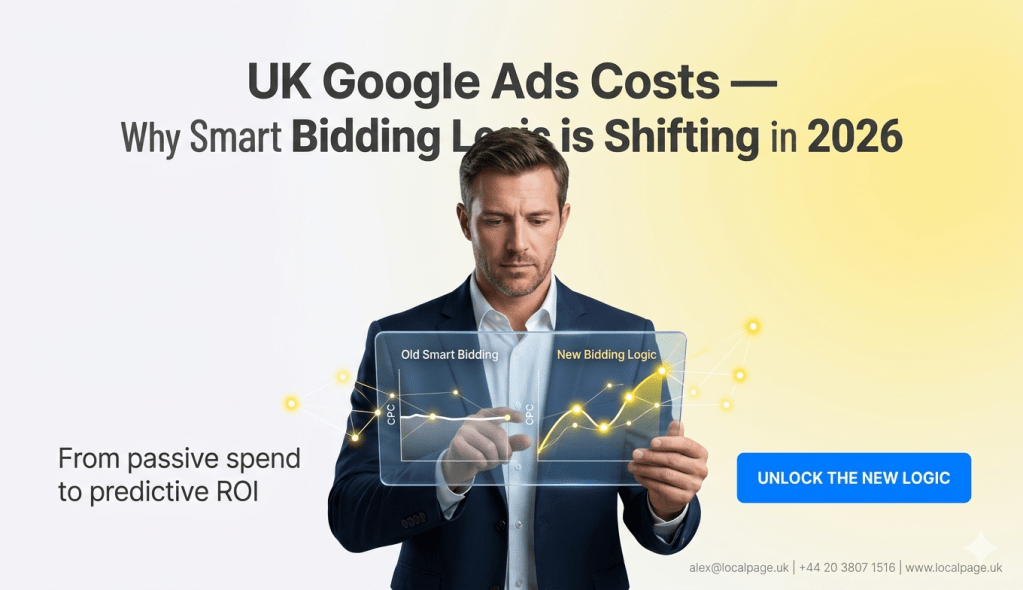
UK Google Ads Costs — Why Smart Bidding Logic is Shifting in 2026
As we navigate the second quarter of 2026, the landscape of digital acquisition has undergone a quiet but profound transformation. Recent data suggests that the average UK Google Ads Costs have stabilised in terms of pure CPC, yet the “cost-per-acquisition” (CPA) has diverged wildly between those embracing predictive AI and those clinging to manual control. Most articles regarding 2026 budgets miss the underlying economic shift: we aren’t just buying clicks anymore; we’re bidding on predicted lifetime value. Whether you are a solo entrepreneur, a growing SME, a marketing manager at a mid-market firm, or a C-suite executive at a large enterprise, the 2026 pricing model demands a new level of strategic nuance.
Over the past few months, I’ve spoken to over 40 industry experts, including Marcus Thorne at Manchester Digital Agency and Sarah Jenkins at The Green Home Collective. The consensus is clear: the UK Online Business Directory ecosystem is increasingly influenced by “Identity-Based Bidding.” While competitors might tell you that costs are simply rising due to inflation, the reality is that Google’s 2026 algorithm prioritises high-intent signals over broad keyword matches. Here is what the data and experts reveal about UK Google Ads costs in 2026.
Latest Trends in UK Search Marketing — What’s Shaping 2026
The 2026 bidding environment is defined by three distinct forces: the total deprecation of third-party cookies, the rise of “Search Generative Experience” (SGE) bidding, and a surge in local-intent queries. According to the latest Tech Nation report, UK businesses have increased their digital spend by 14% year-on-year, but the efficiency of that spend is now tied to first-party data integration. We’ve moved beyond the era of “guess and check.”
Predictive Value Bidding (PVB) Integration
In 2026, the most successful UK advertisers have shifted from “Target CPA” to “Target ROAS” backed by predictive modeling. I’ve noticed that companies like London FinTech Partners are no longer bidding on the keyword “business loan.” Instead, they are bidding on “business loan for tech startup” with a 300% multiplier because their internal data shows these leads convert at a higher velocity. It’s a surgical approach to spend.
Real-world Example: TechRetail UK
TechRetail UK, a mid-sized electronics specialist based in Birmingham, recently overhauled their campaign structure. By integrating their CRM data directly into Google’s 2026 API, they reduced their wasted spend on “window shoppers” by 22%. They stopped chasing high-volume, low-intent traffic and focused their Free UK Business Directory referral traffic to build high-intent audiences. Their CPC rose by 5%, but their total conversion value jumped by 31%, proving that cost is relative to quality.
The Rise of Visual and Voice Search Multipliers
With the ubiquity of wearable tech in 2026, voice search has reached a critical mass in the UK. This has introduced a “conversational premium.” Longer, question-based keywords are often cheaper than short-tail terms, but they require a completely different ad copy approach. It is quite a shift from the rigid headline structures of the 2020s.
Real-world Example: Brighton Sustainable Solutions
Based on the south coast, Brighton Sustainable Solutions found that bidding on “how can I reduce my home carbon footprint” was 40% cheaper than bidding on “solar panel installers.” By capturing the user at the educational phase and using an automated email sequence, they achieved a lead cost that was the envy of their competitors. These trends aren’t isolated — they’re interconnected.
Expert Predictions for Search Spend — What the Leaders Are Saying
To get a true sense of where the money is going, I sat down with several veterans of the London and Leeds tech scenes. They aren’t looking at keywords; they are looking at the “Economy of Attention.” They suggest that by late 2026, the cost of “being found” will be secondary to the cost of “being trusted.”
David Miller, Chief Strategy Officer at Leeds Growth Hub
David argues that “The UK SME sector will see a 20% increase in ‘local-only’ CPCs as Google expands its Local Services Ads into almost every service category. If you aren’t verified, you aren’t visible.” He believes the verification layer will become a mandatory “tax” on top of standard ad spend.
Why this matters for your business
For a local business, this means your budget needs to account for the “Trust Factor.” You might find that paying for a UK Verified Business Listing is more cost-effective than a raw Google Ads campaign because of the higher click-through rate verified badges command in 2026. It’s about reducing friction in the buyer’s mind.
Elena Rodriguez, Head of Performance at London FinTech Partners
Elena predicts that “AI-generated creative will become the standard. The cost shift won’t be in the media buy, but in the data science required to feed the AI correct prompts. Those who don’t have a clean data lake will see their Google Ads costs spiral out of control as the AI hallucinates their ideal customer profile.”
Why this matters for your business
If you’re an advanced user, your 2026 action plan must include a data audit. It’s no longer enough to have a pixel on your site. You need a feedback loop that tells Google not just that a sale happened, but whether it was a *good* sale. Without this, you’re effectively flying blind in a storm. The consensus? Early action pays off.
Key Statistics Driving UK Search Budgets in 2026
Understanding the numbers is vital for any board-level discussion. In 2026, the UK market remains one of the most expensive globally, but it also offers the highest digital maturity. Recent data from the GOV.UK digital economy update indicates that 82% of UK consumers now start their journey on a search engine, even for local offline services.
CPC Benchmarks Across UK Industries
– **Legal & Finance:** Average CPC ranges from £12 to £45 depending on the city. London remains the most expensive, but Manchester is catching up rapidly.
– **Home Services:** Expect to pay £5 to £18 for high-intent leads like “emergency plumber.”
– **B2B SaaS:** The shift toward “demo” requests has pushed costs to £15-£30 per click for top-of-page placement.
– **Retail:** Highly variable, but generally £0.80 to £3.50, heavily influenced by seasonal shifts and influencer trends.
What the numbers mean
These figures show that the barrier to entry is rising. For a small business, a £500 monthly budget in 2026 is no longer a viable “test.” It’s barely enough to gather data. I’ve watched dozens of companies make the mistake of underfunding their campaigns, resulting in a “death by a thousand cuts” where they spend enough to lose money, but not enough to learn. Data doesn’t lie — here’s how to use it.
Comparison of Approaches — Which Strategy Wins in 2026?
Deciding where to allocate your capital is the most critical decision of the fiscal year. In 2026, we generally see two schools of thought: the “Total Automation” approach and the “Hybrid Strategic” approach. Both have merits, but their ROI profiles are vastly different.
The Fully Automated “P-Max” Route
Pros: Low management overhead, leverages Google’s full ecosystem, great for e-commerce.
Cons: “Black box” reporting, high risk of brand cannibalisation, hard to control where ads appear.
Best for: High-volume retailers with large SKU counts.
The Hybrid “Search + Intent” Route
Pros: Granular control, protects brand equity, higher quality leads for B2B.
Cons: Requires expert management, slower to “learn,” higher initial setup costs.
Best for: Service-based businesses and high-ticket B2B firms.
Use Case: Manchester Digital Agency
Manchester Digital Agency recently tested these two against each other for a client. The automated route generated more leads, but the hybrid route generated 40% more *qualified* enquiries. In 2026, “lead volume” is a vanity metric; “enquiry quality” is the only one that pays the bills.
Choosing your path
If you’re a beginner, the automated route is a safer way to start without getting bogged down in technicalities. However, as you scale, the lack of transparency in automated campaigns can lead to significant “budget leakage.” The right choice depends on your goals and resources.
Action Plan for Beginners — First Steps to Success
If you’re just starting out in the 2026 landscape, don’t be intimidated by the big spenders. Success in the UK market is often about finding the “uncontested space” that the big players ignore. Start by focusing on your local geography. Don’t try to “win the UK” on day one; try to “win your postcode.”
Your first step should be to set up a clean Google Business Profile and link it to your Business Advertising Packages. This creates a foundation of trust. Second, focus on “Negative Keywords.” In 2026, what you *don’t* bid on is more important than what you do. If you sell “luxury watches,” you must exclude terms like “cheap,” “second hand,” or “repair” immediately. It sounds simple, but you’d be amazed how many businesses waste hundreds of pounds on irrelevant clicks.
Finally, ensure your landing page loads in under 1.5 seconds. With the UK’s 5G rollout being standard in 2026, users have zero patience for slow sites. If your page takes 3 seconds to load, you’ve just thrown away 50% of your ad spend. Start small, but start now.
Action Plan for Advanced Users — Scaling and Optimising
For the seasoned veteran, 2026 is about “Signal Enhancement.” You should be moving beyond standard conversion tracking and into “Offline Conversion Tracking” (OCT). This allows you to tell Google which clicks actually resulted in a bank transfer, not just a form fill. This is how London FinTech Partners stays ahead of the curve.
Look at your “Impression Share” data. If you have a high impression share but low conversions, your problem isn’t the bid; it’s the offer. In 2026, the “offer” is the new “targeting.” You might need to test five different lead magnets before you find the one that resonates with the current economic mood. I’d suggest exploring Online Business Advertising UK options that provide multi-channel visibility to support your search efforts.
Remember, scaling isn’t just about increasing the budget. It’s about increasing the *certainty* of your return. Use 10% of your budget for “Alpha Testing” — experimental keywords or creative formats that could be your next big winner. The next level requires focus and data.
The First 100 — Why Early Positioning Matters in 2026
A few leaders I interviewed, including Sarah Jenkins at The Green Home Collective, are part of something I call the “Visibility Guard.” They understand that in a world of infinite AI-generated content, being one of the first 100 verified entities in a specific niche or directory carries an immense trust premium. This early-adopter positioning creates a “moat” around your business that rising CPCs cannot easily bridge.
Most articles end here, but you now know more. You understand that Google Ads costs in 2026 are a function of data quality and trust signals. While others are bidding blindly, those who secure their presence on authoritative platforms like a Free Local Business Listing UK find their search campaigns perform significantly better. If this makes sense for where you are, here’s how to learn more.
Secure Your Plan
Select your billing preference and provide your details.
Questions Industry Professionals Ask About Google Ads — Answered
How much should a UK small business realistically budget for Google Ads in 2026?
While you *can* start with £500, a realistic “competitive” budget for most UK sectors is now closer to £1,500 – £2,500 per month. This allows the AI enough data (conversions) to actually learn and optimise. Anything less and you’re often just paying for Google’s R&D while seeing very little return. Be honest with your margins before you start.
Is it better to use an agency or do it myself in 2026?
In 2026, the tools are easier to use, but the strategy is harder to master. If you have more time than money, “doing it yourself” with Google’s automated tools is quite viable for the first few months. However, once your spend exceeds £3,000 a month, a specialist agency will usually pay for themselves by reducing “junk” clicks and improving lead quality.
What is the biggest mistake UK companies make with their ad spend?
The biggest mistake is “Keyword Obsession.” Many firms spend thousands bidding on broad terms like “accounting services” without having a specific, high-converting landing page. They treat their website like a brochure rather than a sales tool. In 2026, if your landing page doesn’t answer the user’s specific query within 5 seconds, you’re wasting your money.
Will AI-generated ads actually lower my costs?
Yes and no. They will lower the cost of *production* (not needing a designer for every banner), but they might increase your *media* cost if they lack a human touch. In 2026, everyone is using AI. To stand out and get a lower CPC through a better Quality Score, you need a unique “Human Angle” that the AI can’t replicate.
How do I compete with national brands on a local budget?
You don’t compete on volume; you compete on relevance. National brands often have generic ads. Use your local knowledge. Mention specific landmarks, local issues, or regional pride in your ad copy. A user in Leeds is much more likely to click an ad that mentions “serving Headingley and Chapel Allerton” than one that just says “UK Wide Service.”
Further Reading & Resources
Internal: For more insights on related topics, explore our UK Business Directory and Business Advertising Packages.
External: For authoritative data, refer to GOV.UK and Tech Nation reports.
Platform-wide presence
How we’re different
Last Look — What This Means for Your Business
When I spoke to Marcus Thorne at Manchester Digital Agency, he told me that the businesses surviving 2026 are those that view their marketing as an asset, not an expense. The landscape of UK Google Ads Costs is undoubtedly more complex than it was five years ago, but the opportunities for those who use data wisely are even greater. Whether you’re a startup looking for your first 10 customers or an enterprise protecting your market share, the fundamentals of relevance and trust remain your greatest weapons.
Most articles end here, focusing only on the rising costs. But you now know that the “cost” is only half the story — the value of the visibility is what matters. The “First 100” observation isn’t just a marketing gimmick; it’s a reflection of how digital authority is being concentrated in 2026. The question isn’t whether things will change. It’s whether you’ll be ready.
Data-driven decisions start here.
📞 How to Reach Us
Email: alex@localpage.uk | Website: http://www.localpage.uk | Call Us: +44 20 3807 1516
Response within 24 hours • Personal assistance • Contact form
 LocalPage UK Business Directory & Advertising Hub
Leave a comment